
Orbit
Orbit is a community growth platform and a corresponding framework — the Orbit Model — for building communities.
About
Orbit is a community growth platform and a strategic framework designed to help organizations build and scale "high-gravity" communities. The framework uses a solar system analogy — also known as the “Orbit Model” — where a community's "gravity" is its ability to attract and retain members. This is measured by two key metrics: "love," which reflects a member's level of engagement and involvement, and "reach," which quantifies their influence and network. The platform provides the tools to track these metrics across various channels like Slack, Discord, and GitHub, giving community managers a holistic view of their community's health and a way to understand the unique role each member plays.
For companies, Orbit is crucial because it transforms the abstract concept of "community" into a measurable, data-driven business asset. It allows for the segmentation of members into different "orbit levels," enabling teams to tailor engagement strategies and create more personalized experiences. By providing a unified view of member activity and impact, Orbit helps companies move beyond spreadsheets to demonstrate the tangible value of their community efforts, whether that's in proving ROI, identifying key contributors, or nurturing a dedicated user base that drives growth.
The Orbit Model.
The Work
I began at Orbit in October 2021. They had a number of different creative initiatives they wanted to do — an academy of video courses, a podcast, etc. — but the first project we moved forward on doing was a print and online magazine (which we eventually named Gravity).
Before starting the magazine, we had to come up with a name for it.
Orbit doesn’t have a style guide or internal branding; everything is usually named after some type of space-related concept. Even with that, I did guide some of the key stakeholders at the company (the CEO, our head of Growth, and our creative director) through a brainstorming exercise to generate ideas, and to then narrow those ideas down.
A screenshot of the Miro board we use for the brainstorming exercise. Each participant wrote down a name on one of the green squares, and then they put their top ideas in the center square. We used the top choices in a poll for Orbit employees, and then had them vote on the idea they liked best (each vote is indicated by the red circles.)
A close-up look at the Miro board.
Once we had the name for the magazine, then we decided on the other particulars about the magazine, such as frequency, audience, etc. We settled on making Gravity a quarterly magazine, which we would publish in print and online. Each issue would have an overall theme, and the content inside would focus on the theme. I served as editor in chief of the magazine, and was responsible for content strategy as well as editorial review. Employees from Orbit were drafted to write the content, and I created a workflow that would allow content and artwork to be created and edited concurrently in order to keep us on a quarterly publishing schedule for print and Web.
A diagram showing the production process for the first issue.
In our content strategy meetings, we used Miro to gather ideas and categorize them by content type using a mind map. From here, I’d hold an editorial review meeting to narrow these topics down into about 9-10 pieces that I could assign to writers, and production would go from there.
A mind map of content for our first issue.
A close up of the mind map of content for our first issue.
I also worked with our in-house creative director on concepts for the cover artwork and the artwork for individual articles. Since everything had to be space-themed, we had a lot of content to choose from and many different eras to use as inspiration. We ended up going with a more 50’s space race theme to match Orbit’s current retrofuturistic branding.
A screenshot of the Figma board we used for cover inspiration.
A bunch of different potential sketches for the cover.
We published the first issue online and in print in March 2022. Here are some shots of the cover and some interior pages of the magazine.
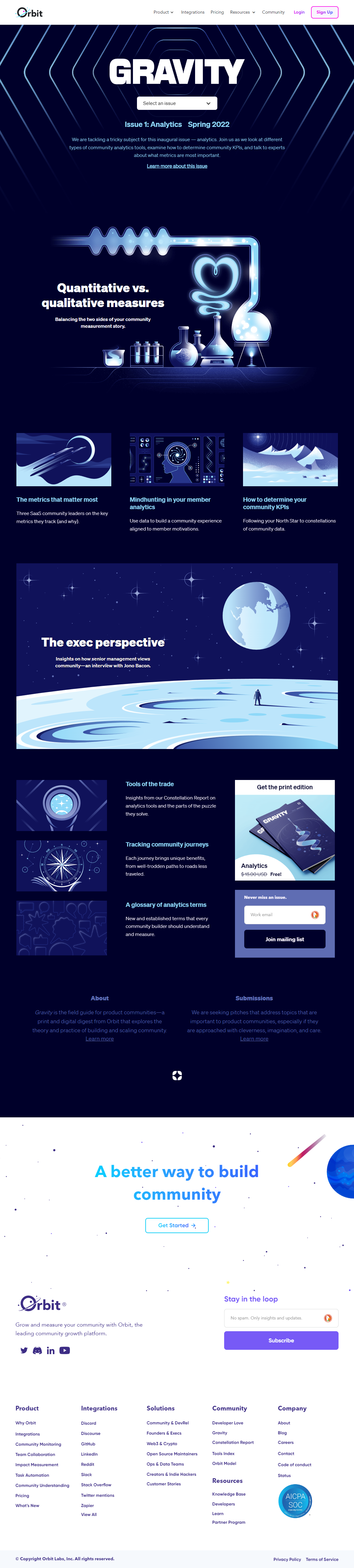
This is the Web version of Gravity for issue 1. Each article has its own dedicated page, and you can browse between issues using the dropdown bar at the top of the page.
After we published this first issue, I created a roadmap of content for issues through Q2 2023. Issue 2 (Community Growth) published in August 2022, and Issue 3 (Web3), is set to publish in December 2022.
A screenshot of the mood board in Figma used for the cover of the second issue.
This is the Web version of issue 2 of Gravity.
Conclusion
My time at Orbit successfully laid the foundation for quarterly issues of Gravity through mid-2023. Ultimately, the work was concluded to align with a broader shift in company priorities. Orbit was acquired by Postman in 2024 and has shut down operations.